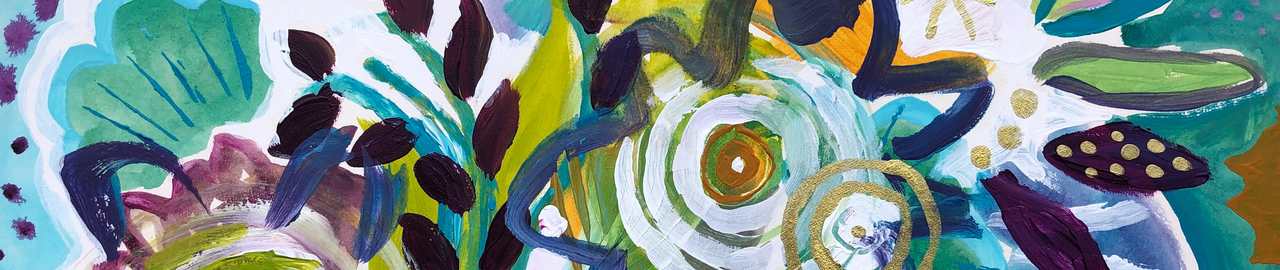
The inner Journey

The Inner Journey in the Work of Karin Toma
The work of Karin Toma can be understood as an ongoing exploration of the inner world of the human being. Her oeuvre, which spans several series such as The Search, Hope for More, and Bloom!, reflects a development that is not primarily directed toward external reality, but toward a process of inner awareness and transformation.
The Path Inward as an Artistic Point of Departure
At the core of Toma’s work lies the idea that art is a means of accessing inner life. She describes creativity as a process of letting go, following intuition, and connecting with the unconscious. Art does not arise from control or technical mastery, but from surrendering to an inner flow of images and emotions.
This vision closely aligns with the psychology of Carl Gustav Jung, who regarded the unconscious as a source of symbols and archetypes. Like Jung, Toma sees the creative process as a way of making hidden layers of the psyche visible. Art thus becomes a form of inner dialogue through which the individual comes to know themselves.
Art as Spiritual Development
In addition to Jung, the ideas of Rudolf Steiner are clearly reflected in Toma’s approach. Steiner emphasized that art forms a bridge between the material and the spiritual. A similar perspective emerges in Toma’s writings: she speaks of the interconnectedness of human beings, nature, and the cosmos, and of dissolving the boundary between the “self” and the “other.”
Within this context, her work takes on an almost meditative quality. Painting becomes not a representation of the visible world, but a means of experiencing a deeper reality. This resonates with the anthroposophical view that art can contribute to inner growth and the development of consciousness.
The Childlike and the Free Gesture
A third important influence is Arno Stern, known for his advocacy of free expression without judgment. Stern viewed drawing and painting as autonomous processes that should not be directed by external norms or aesthetic expectations.
Toma’s working method reflects this principle. Rather than offering traditional instruction, she creates a space in which participants can experiment freely and follow their own creative process. This highlights the importance of authenticity: art emerges only when the creator frees themselves from external pressure and returns to an original, almost childlike state of making.
The Spiritual in Art
The ideas of Wassily Kandisky, particularly from his book Über das Geistige in der Kunst, provide an important theoretical background for Toma’s work. Kandinsky argued that art must express an inner necessity and that color and form are directly connected to the human soul.
In Toma’s series, such as Atmosphere and Synergy, emphasis is placed on vibration, energy, and emotion. Even the titles suggest a reality that is not tangible, but must be felt. This corresponds with Kandinsky’s idea that art should not imitate external reality, but evoke an inner resonance.
Art as a Process of Connection
Ultimately, what characterizes Karin Toma’s work is its emphasis on connection: with oneself, with others, and with the world as a whole. By exploring the inner world, a deeper understanding emerges of the interconnectedness of all things.
This vision transcends the individual artwork and touches on a broader societal dimension. Creativity becomes a means of self-determination and transformation, both on a personal and collective level. Art is therefore not merely an aesthetic experience, but also an existential and even ethical practice.
Conclusion
The work of Karin Toma can be seen as a contemporary continuation of a spiritual tradition in art in which inner experience is central. Inspired by Jung, Steiner, Stern, and Kandinsky, she develops a practice in which art functions as a path toward self-knowledge, freedom, and connection.
In a time in which emphasis is often placed on external achievement and visible results, her work offers an alternative perspective: art as an inner journey, as a search for meaning, and as a way of reconnecting with the essence of being human.